
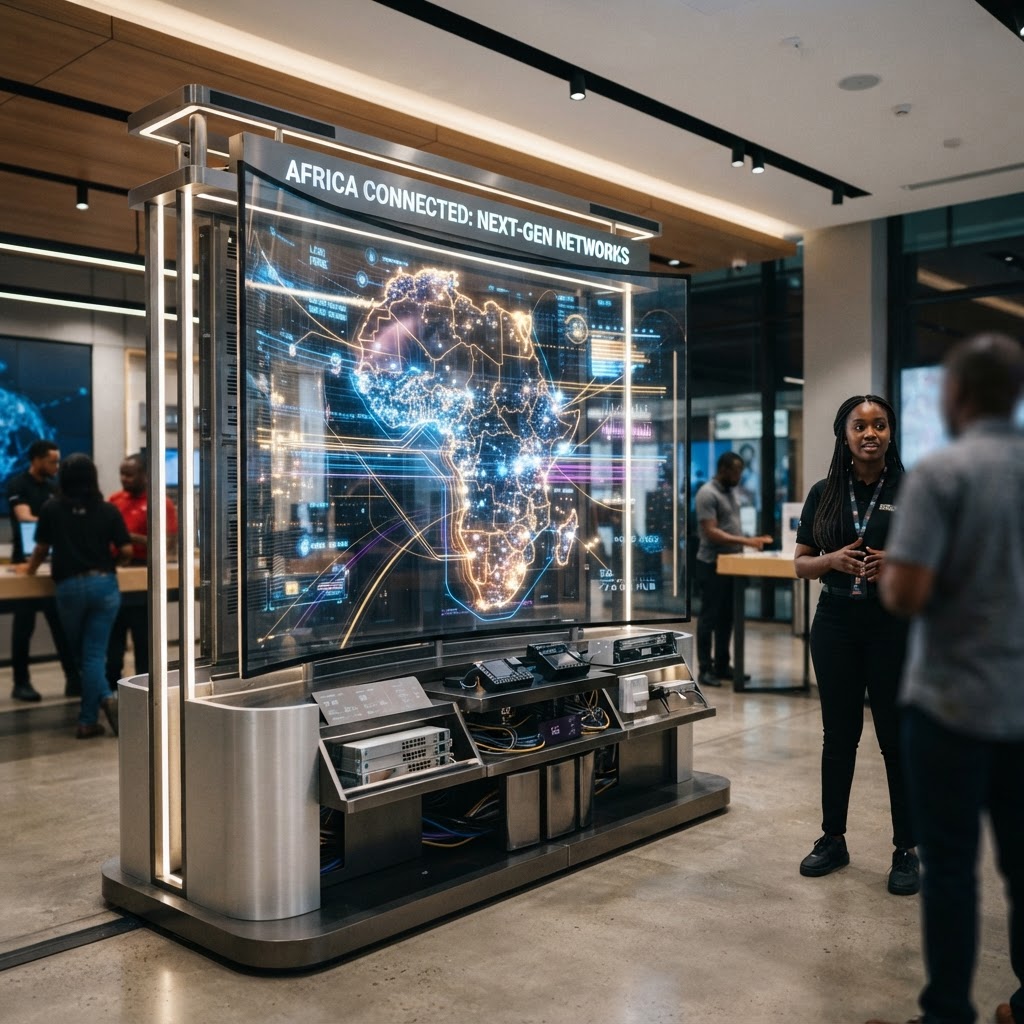
South African mobile users are getting a glimpse of a hyper-connected future this week, as MTN and technology giant ZTE unveil a groundbreaking 5G-Advanced trial at the V&A Waterfront in Cape Town. The demonstration, which pushes the boundaries of what local networks can achieve, highlights a new era of digital infrastructure that promises to redefine the way we consume data, work, and interact with technology. At the heart of this showcase is a massive leap in transmission capacity. During the live public demonstration, engineers recorded staggering download speeds reaching 9.2 gigabits per second. To put this in perspective, this is a speed increment that turns the current standard 5G browsing experience into something akin to a legacy dial-up connection. By deploying specialized millimeter-wave active antenna hardware, the two companies have essentially unlocked a high-frequency lane that was previously underutilized in the local market. For the average South African consumer, this technology represents far more than just faster movie downloads. The implications are profound for our burgeoning digital economy. With such massive throughput, industries can move beyond basic connectivity and into the realm of real-time, high-bandwidth applications. This includes, for instance, high-definition robotics that can be controlled remotely with near-zero latency, and the deployment of glasses-free 3D holographic displays that require vast data streams to maintain image integrity. This milestone serves as a vital signal to the global tech investment community that South Africa is serious about maintaining its reputation as a leading telecommunications hub on the continent. While many nations are still wrestling with basic network stability, the ability to test and integrate 5G-A architecture keeps our local mobile landscape relevant in an increasingly competitive global environment. Local network operators are under constant pressure to provide seamless connectivity to a population that relies heavily on mobile access for banking, education, and social interaction. MTN’s latest move suggests a strategic pivot toward future-proofing its infrastructure before the demand for such high-intensity applications becomes a daily reality. The partnership also underscores a growing trend of collaborative innovation, where global hardware suppliers and local network operators work in tandem to customize network performance for specific geographical needs. This trial acts as a testing ground for what will eventually become the backbone of our country’s commercial connectivity. As we look toward the inevitable commercial rollout of these networks, the focus will likely shift to how these speeds can be extended beyond major metropolitan retail hubs and into the broader economic landscape. Ensuring that this cutting-edge capability reaches underserved sectors remains the next logical hurdle. Nevertheless, the successful demonstration at the V&A Waterfront confirms that the technical foundation is not only present but performing at world-class standards. By bridging the gap between theoretical research and tangible public experience, MTN and ZTE have set a new benchmark for telecommunications in Africa. The race toward the next generation of mobile connectivity is well underway, and South Africa is currently occupying a front-row seat.
About the Author
Thabo Ndlovu
Staff Reporter
Thabo Ndlovu reports for National Post UK with a focus on rigorous analysis and authoritative journalism — a trusted voice across British public life.
Reader Discussion · 4
Subscribers can join the conversation.
SUBSCRIBE TO COMMENT →I have used MTN for years and while their network is decent, the cost of data remains a real barrier for most people. Hopefully, these efficiency gains lead to lower pricing for the end user rather than just higher profit margins for the operators.
This is a significant step forward for South African telecommunications. The partnership with ZTE suggests they are aiming to lead the continent in digital transformation, which will hopefully attract more international investment to the region.
While faster speeds sound great on paper, I am not convinced the average consumer actually needs 5G-Advanced yet. We should be focusing on making basic, reliable internet affordable for everyone across the country rather than chasing headline-grabbing trial speeds.
It is impressive to see the V&A Waterfront being used as a testbed for this technology. I visit Cape Town every year and mobile connectivity has improved drastically, though I do wonder if the infrastructure outside the major city hubs will be prioritised anytime soon.